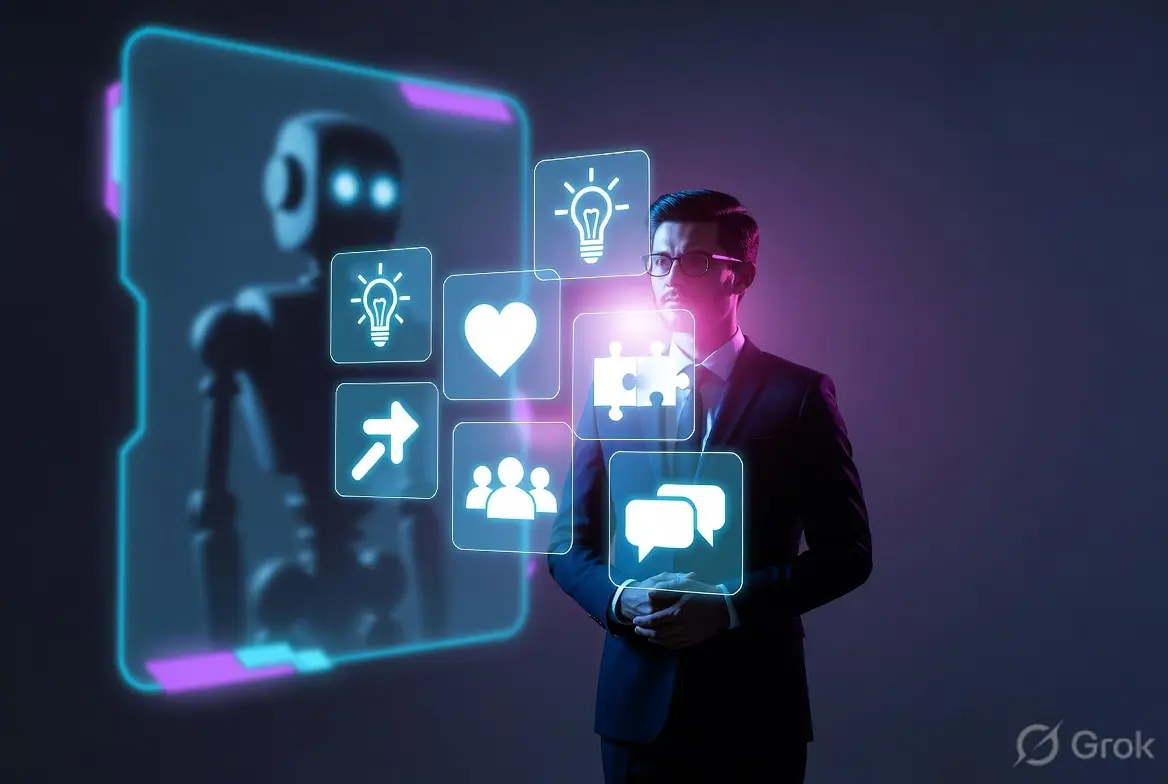
In today’s rapidly evolving job market, acquiring future-proof career skills is essential to remain relevant and competitive alongside AI. While artificial intelligence automates routine tasks, human abilities like critical thinking, emotional intelligence, and strategic decision-making ensure long-term professional growth and security.
Can a chatbot write your performance review, or handle your next sales call, or soothe your most dissappointed client? That’s the question companies are asking. And if you can’t do those things – and most of us can’t – then you need power skills. These are skills that no computer can acquire, like managing people, taking responsibility for mistakes, and negotiating effectively. Power skills are fast becoming the most valuable assets in the new economy.
What Are Power Skills, and Why Do They Matter Now?
Power skills, sometimes referred to as soft skills or human skills, are the skills that make humans unique compared to computers, robots, and artificial intelligence systems. They include critical thinking, communication, creativity, and emotional intelligence. However, for a long time, they were considered a “nice to have” area of expertise and were overshadowed by technical competencies. But things are now changing.
The research study conducted by PwC, “2026 Global AI Jobs Barometer”, that analyzed over one billion job postings in 27 countries and territories, shows that there is an increased demand from employers worldwide to hire people who have judgment, creativity, and leadership skills. The report by the World Economic Forum entitled “The Future of Jobs Report” confirms this trend and reveals that analytical thinking is going to be the most in-demand core skill for 2025, while resilience, flexibility, and leadership will be the second, third, and fourth most sought-after skills, respectively.Building these future-proof career skills is no longer optional for professionals who want to stay relevant.
Why AI Can’t Replace These Human Skills (Yet)
Understanding why AI cannot replicate human judgment highlights the true value of future-proof career skills in the modern workplace.While AI systems are excellent at pattern recognition they perform badly when it comes to judgment, intuition and trust. When a project goes awry, a client is demanding, or a team needs to be motivated, a human is needed to handle these judgemnt calls, rather than an algorithm that may accurately predict the next most likely word. It is this fundamental difference between pattern identification and judgement that makes the difference between the skills sought after by employers in the new two track job market.
PWC has identified this two track job market, with jobs that are being augmented by AI to create more judgmnet rich posts, as a shift towards a two-speed labour market. This is because the jobs that AI is performing, or assisting humans to perform, are being replaced by a greater number of judgement rich jobs that utilise the skills of people working alongside AI. Simplistically this can be thought of as either your job is being performed by an AI or it is being assisted by an AI.
The 7 Essential Future-Proof Career Skills Employers Want Most in 2026
1. Critical Thinking in the AI Era
AI gives you answers instantly, but someone still has to decide if those answers are correct, relevant, and safe to act on. Employers want people who can question an AI-generated report, spot a flawed assumption, and make the final call.
2. Creative Problem-Solving
Generative tools remix what already exists. Genuinely new ideas — a product pivot, a marketing angle nobody’s tried, a fix for a problem with no playbook — still come from people.
3. Emotional Intelligence and Empathy
Empathy and active listening are two of the top skills the World Economic Forum predicts will be in highest demand through 2030. Navigating difficult conversations, reading a client’s non verbal signals, and being there for your team’s personal needs all require a certain level of emotional intelligence.
4. Adaptability and Resilience
Tools, processes, and even job descriptions themselves are constantly evolving and transforming within a span of several months. Resilience, adaptability, and agility are right there alongside analytical thinking in the list of skills that employers value. People who can roll with the punches and continue to learn are going to stick around longer than those who can’t.
5. Communication and Storytelling
Data means nothing if you can’t explain why it matters. Whether you’re pitching a client, writing a proposal, or presenting to leadership, the ability to turn information into a clear, persuasive story is a career skill AI still can’t fully own.
6. Leadership and Social Influence
Someone has to set direction, rally a team, and make a call under pressure. Leadership and social influence made the top four core skills in this year’s employer survey, and that’s not a coincidence — teams working alongside AI still need a human steering the ship.
7. Curiosity and Lifelong Learning
The half-life of a technical skill keeps shrinking. Staying curious, testing new tools, and treating learning as an ongoing habit rather than a one-time course is what keeps you relevant three, five, ten years from now.
AI Skills vs. Power Skills: What Employers Actually Want
| What AI Does Well | What Still Needs a Human |
| Processes data at scale | Decides what the data means |
| Drafts content instantly | Judges tone, context, and audience fit |
| Automates repetitive tasks | Handles ambiguity and exceptions |
| Answers known questions | Builds trust and relationships |
| Follows instructions | Sets strategy and direction |
Combining technical knowledge with future-proof career skills gives you a major competitive advantage in hiring.
Here’s the thing: This is not about skills related to artificial intelligence, rather the World Economic Forum argues that the job market will see the most growth for people who possess technical skills related to AI while also having interpersonal skills such as imagination and empathy by 2030. The lesson is to become familiar with the tools and then bring something to the table the tools cannot.
How to Build These Skills — For Job Seekers, Professionals, and Students
Here is how job seekers and students can start developing future-proof career skills today:
- Job seekers: Rewrite your resume around outcomes, not tasks. Instead of “used AI tools,” write “used AI drafting tools to cut proposal turnaround by 40%, then reviewed and finalized every client-facing detail myself.”
- Working professionals: Volunteer for the messy, ambiguous project nobody wants. That’s where judgment, communication, and leadership actually get tested and noticed.
- Students: Group projects, part-time jobs, and campus clubs all offer cheap and easy ways to build leadership and communication skills – don’t waste your time on more classes if you can learn by doing in other ways.
- Instead of getting more certifications, get small amounts of practice on a regular basis
- Practice talking through a difficult decision, ask for criticism after a hard conversation, and study how other leaders handle meetings and negotiations. All of these things help develop stronger communication and leadership skills.
Frequently Asked Questions
What are power skills in the workplace?
Power skills are human abilities like critical thinking, communication, emotional intelligence, and leadership. Developing these future-proof career skills helps people make judgment calls, connect with others, and adapt to change — things AI tools can’t reliably do on their own.
Will AI replace soft skills jobs?
No. AI is automating routine and repeatable tasks, but roles that depend on judgment, trust, and human connection are growing, according to PwC’s 2026 AI Jobs Barometer.
Which soft skill is most in demand in 2026?
Analytical or critical thinking currently tops most employer surveys, including the World Economic Forum’s Future of Jobs Report, followed closely by resilience, flexibility, and leadership.
Can I learn power skills, or are they natural talent?
They’re learnable. Communication, emotional intelligence, and leadership all improve with deliberate practice — feedback, reflection, and real-world reps, not just reading about them.
Do I need power skills if I already have technical AI skills?
Yes. The strongest job prospects belong to people who combine technical AI fluency with human skills like creativity, empathy, and adaptability, not one or the other.
How do I show power skills on a resume?
Use specific examples with outcomes: a conflict you resolved, a project you adapted mid-course, a presentation that changed a decision. Avoid vague claims like “great communicator” with no evidence behind them.
The Bottom Line
The AI revolution will make the professional world even more competitive. Not for those who seek to avoid it or who try to rely on it too much – but for those who use it alongside judgment, empathy, and leadership, the traits a machine cannot mimic. The challenge for every professional is to pick at least one power skill that he has not invested enough in and dedicate some time to improving it in the next few months.Focus on investing in future-proof career skills to build a resilient and growth-oriented career.
