
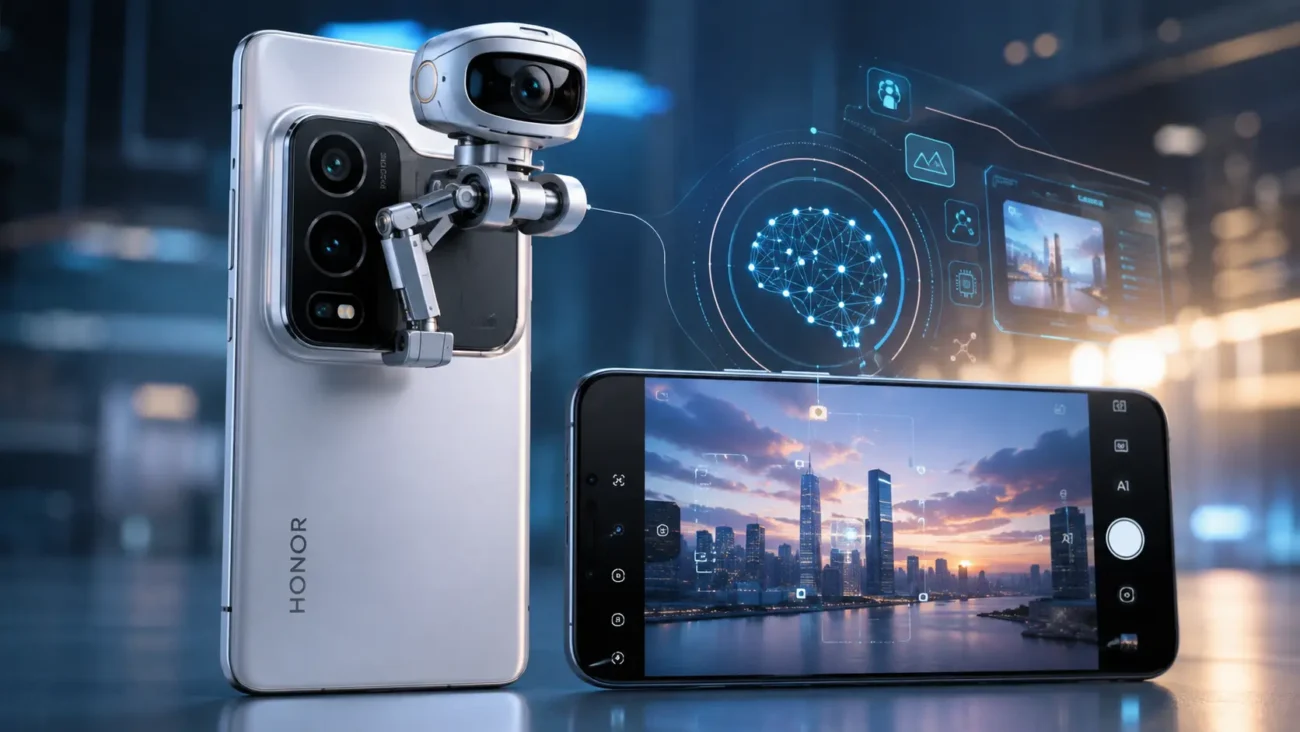
Imagine a phone camera that can look around a room on its own, follow you while you talk, and even nod along to your favourite song. That’s not science fiction anymore. It’s the Honor Robot Phone, and it’s one of the strangest, most talked-about gadgets of 2026.
If you’ve seen a video online of a smartphone camera popping up and moving like a tiny robotic arm, you’ve already seen it in action. Let’s break down what this phone actually is, how its camera works, and whether it’s worth the hype.
What Is the Honor Robot Phone?
The Honor Robot Phone is a flagship smartphone from Honor, a Chinese phone manufacturer that used to be a subsidiary of Huawei. The key difference between this phone and all other smartphones is that its main camera is not fixed on the phone’s chassis. Instead, it is mounted on a robotic arm. It can move, rotate, and even track you down in a room.
The company calls it a gimbal. A gimbal is usually a standalone device, like a phone gimbal that YouTubers often use to stabilize their phones while recording videos. Honor essentially incorporated a gimbal into the phone’s design. It is concealed by a tiny sliding cover on the back of the phone.
To activate the gimbal, you need to open the cover and unfold the robotic arm. It is also possible to use a hand gesture to unlock it and start recording.
How Does the AI Camera Actually Work?
This is where things get genuinely clever. The Honor Robot Phone’s camera isn’t just moving randomly, it’s guided by artificial intelligence in real time.
Here’s a simple breakdown of what’s happening behind the scenes:
- AI subject tracking: The camera can lock onto a person and follow them automatically. Double-tap on someone in the viewfinder, and the AI keeps that person centred in the frame, even if they walk around or get briefly blocked from view.
- Physical stabilisation, not just software: Most phones use software tricks to smooth out shaky video. The Robot Phone uses a real, physical titanium gimbal with four degrees of freedom, so it can pan, tilt, roll, and rotate. That means smoother, more natural-looking footage without needing a separate handheld gimbal.
- Voice and gesture control: You can tell the camera to turn around or focus on something specific, and it responds. No need to touch the phone at all.
- Cinematic movement modes: Honor built in several camera movement styles, including one called “AI SpinShot,” which does a smooth 90 or 180-degree rotation for dramatic video transitions, similar to something you’d see in a professionally shot film.
In plain terms, the AI is doing the job of a human camera operator, deciding where to point the lens, when to move it, and how to keep you in shot, so you don’t have to.
The Camera Specs, Explained Simply
Numbers like “200 megapixels” can sound impressive but confusing. Here’s what’s actually inside the Honor Robot Phone’s camera system, in everyday language:
- Main camera (on the moving arm): A 200-megapixel sensor, which means it captures extremely sharp, detailed photos, even when you crop into them later.
- Telephoto camera: Another 200-megapixel sensor built for zooming in on faraway subjects without losing quality.
- Ultra-wide camera: A 50-megapixel lens for fitting more into the frame, useful for landscapes, group photos, or tight spaces.
- Video quality: It can film in 4K, and it supports professional colour profiles thanks to a partnership with ARRI, a company whose cameras are used to film real Hollywood movies.
That ARRI partnership matters more than it might sound. It means the footage from this phone can look closer to what you’d get from proper filmmaking equipment, rather than the flatter, less detailed look typical smartphone video often has.
Meet Yoyo: The Phone’s AI Personality
Honor didn’t want just a clever camera, it wanted an engaging companion, which is where Yoyo, the phones inbuilt AI comes in.
Yoyo can be seen as an animated character on screen or can be seen controlling the camera arms to perform actions.
Asking it questions makes the camera nod in response or dancing to music played on the phone causes it to bob its head along to the rythem.
It almost gives the sense that the AI has been given a face and body to look at, not just a window to type in, although whether this is a good or bad thing, is subjective, it does make the phone stand out on store shelves and is undeniably conversation piece.
Who Is This Phone Actually For?
The Honor Robot Phone is obviously designed with a very specific type of user in mind; videographers, both professional and amateur. Bloggers, content creators, and streamers who currently have to mount their phones on an external gimbal when filming or live-streaming will no doubt be very excited by the prospect of in-built stabilisation.
However, if this doesn’t sound like you, the ability to track moving objects in real-time while filming a video call may still be useful. Especially if you’re struggling to keep your phone steady while video calling with friends and family.
Price and Availability
The Honor Robot phone currently released in China, costs approximately $1,480 for the base model with 12GB of memory and 512GB of storage, rising to roughly $2,075 for the higher RAM and storage option. There is currently no official price or release date for the US or UK, and Honor phones have previously been restricted in the US market, so wider availability is not guaranteed.
Is It Worth the Hype?
Although early reviews are based on hands-on experience, it seems that this product is not a complete novelty, and those who have tested it noticed that its tracking system is pretty smooth and realistic. Therefore, most articles and videos focus on the technology and its ability to rotate with the user’s head movement. However, as noted in several articles, such a complex mechanism will inevitably be more susceptible to damage than a regular camera, and only time will tell how useful such a device will be in everyday use.
Thus, it becomes evident that the Honor Robot Phone is only the beginning of the new era of technological advancement. Today, mobile phone producers try to make devices as sophisticated and advanced as possible by introducing mechanisms that actively respond to gestures. Although it remains unclear whether such innovations will become commonplace in the future, they will shape the industry for the next few years.