
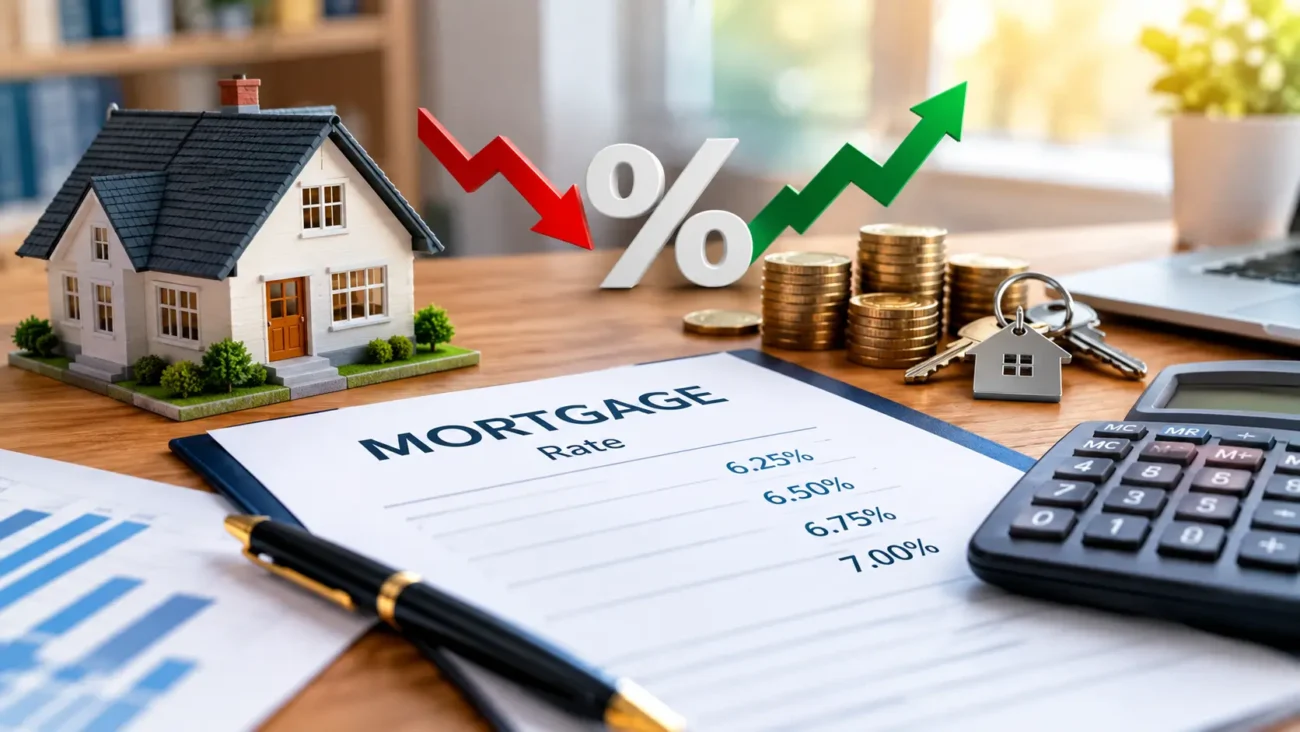
| Quick Answer As of late September 2026, the average 30-year fixed mortgage rate sits around 7.03%, up from 6.95% the week before and well above the 6.30% average recorded a year ago. Rates are climbing mainly because Treasury bond yields have been rising, driven by stubborn inflation and lingering uncertainty tied to the Iran conflict. In short: borrowing money for a home costs more right now than it did last year, and that’s largely out of any single lender’s hands. |
What Are Mortgage Rates Today, Exactly?
A mortgage rate is the cost that is paid to borrow money to purchase an investment property. In addition, the rate is typically quoted as a percentage and can increase or decrease by thousands of dollars depending on the time frame of the loan.
As of September 25, 2026, rates across the board are fluctuating, even daily. The average interest rate for a 30-year fixed-rate purchase mortgage was 7.477%. According to the latest Freddie Mac weekly survey, as of September 24, 2026, the 30-year fixed rate is at 7.03%, and the 15-year fixed rate is at 6.42%.
There is a slight variance between the numbers coming from different organizations. The reason for this is that while some reflect daily lender offers, which tend to fluctuate rapidly, Freddie Mac’s is a weekly average pulled from banks, credit unions, and mortgage companies.
Why Are Mortgage Rates Changing So Much Right Now?
This is the part everyone wants to know about. Mortgage rates do not randomly increase because a bank decides so one morning at work. They follow the bond market, specifically a 10 year treasury
Here’s a list of events that lead to a jump in mortgage rates
Investors gets nervous about inflation or global conflict happens
Investors demand higher yield (return) on their investment in the 10 year treasury (so the yield on the 10 year treasury goes up)
Mortgage lenders (your mortgage company) then also increase rates since they price mortgages based on the 10 year treasury
That’s exactly what is happening here. Mortgage rates jumped because the yield on the 10 year treasury jumped up to 5.183%. This caused mortgage rates to rise for the second consecutive session. The cause for higher yields was inflation worries due to international conflict. Average 30 year mortgage rates jumped higher as the war with Iran increased inflation fears after hitting their lowest level since September 2022 back in February. One finance guy put it best, “Whenever the war seems to escalate, mortgage rates and 10 year treasury rates tend to rise, while the opposite tends to happen when tensions begin to ease”. So as you can see, mortgage rates are driven not by what happens in your local bank, but by fear and uncertainty in the world.
Doesn’t the Federal Reserve Control Mortgage Rates?
This confuses a lot of people, so let’s get this straight: not directly. The fed funds rate set by the Federal Reserve affects longer-term rates, such as those for mortgages, indirectly, but it has a much more direct impact on the rates for credit cards, car loans, and savings accounts. Mortgage rates are typically much longer term and are often more closely related to bonds.
The Federal Reserve, however, has an enormous indirect impact on the mortgage rates by influencing the thoughts of investors in the bond markets.
Fixed vs Adjustable Rate: Which One Actually Saves You Money?
The fixed-rate mortgage is the simplest, safest type. The interest rate on it is fixed for the entire period of the contract, which means that payments will never change for reasons beyond the borrower’s control. An adjustable-rate mortgage (ARM) is typically more attractive at the beginning because the rate on it is lower, but eventually rises over time.
The nuance here is that what was previously typical is no longer typical due to recent trends. A five- or seven-year ARM has now seen its rates converge with those of thirty-year fixed-rate mortgages. Put another way, the discount for taking on more risk has evaporated. In other words, there is no reason to go for an ARM when there is a fixed-rate mortgage option available now.
What This Means for You Right Now
If you’re buying a home: don’t wait around, hoping for a bigger drop. Rates have jumped and fallen by more than 0.2% in a single week this September alone. Get pre-approved, compare at least three lenders, and lock in a rate before you find a house you can afford – trying to chase an ideal rate will cost you dearly if you pass on a house that takes your breath away.
If you’re thinking about refinancing: run the numbers before calling anyone. The average rate for a 30-year fixed refinance rose by a whopping 19 basis points to 7.61%, which is substantially higher than rates for purchase loans. In other words, refinancing only makes sense if you’re going to significantly reduce your rate, taking into account the closing costs you’ll owe.
If you’re a first-time buyer concerned about being able to afford a mortgage: look into assistance programmes and VA loans, if you qualify. There are programmes designed to help first-time buyers who are concerned about being crushed by higher rates, and many people fail to take advantage of them simply because they don’t know about them.
Where Are Mortgage Rates Headed Next?
Nobody is certain about this: any expert claiming to know for sure is likely to be wrong. But most market analysts expect interest rates to gradually come down if inflation cools and international tensions ease — but not sharply enough to quickly return the rates to their 2021 levels (which were below 3%). Watch out for Treasury yields and inflation with particular attention (e.g., CPI data), as they are the best indicators of where mortgage rates are going.
FAQ
What is a good mortgage rate today?
Anything close to or below the current national average — roughly 7% for a 30-year fixed loan — is considered reasonable in today’s market. Your personal rate depends on your credit score, down payment, and loan type.
Why did my mortgage rate quote change from yesterday to today?
Mortgage rates can shift daily because they’re tied to bond markets, which react constantly to economic news, inflation data, and global events.
Is it better to get a 15-year or 30-year mortgage right now?
A 15-year mortgage typically has a lower rate but a higher monthly payment. A 30-year mortgage spreads the cost out with lower monthly payments but more interest paid over time.
Should I wait for mortgage rates to drop before buying a house?
Timing the market perfectly is very hard, even for experts. Many buyers choose to buy when they’re financially ready and refinance later if rates fall.
