
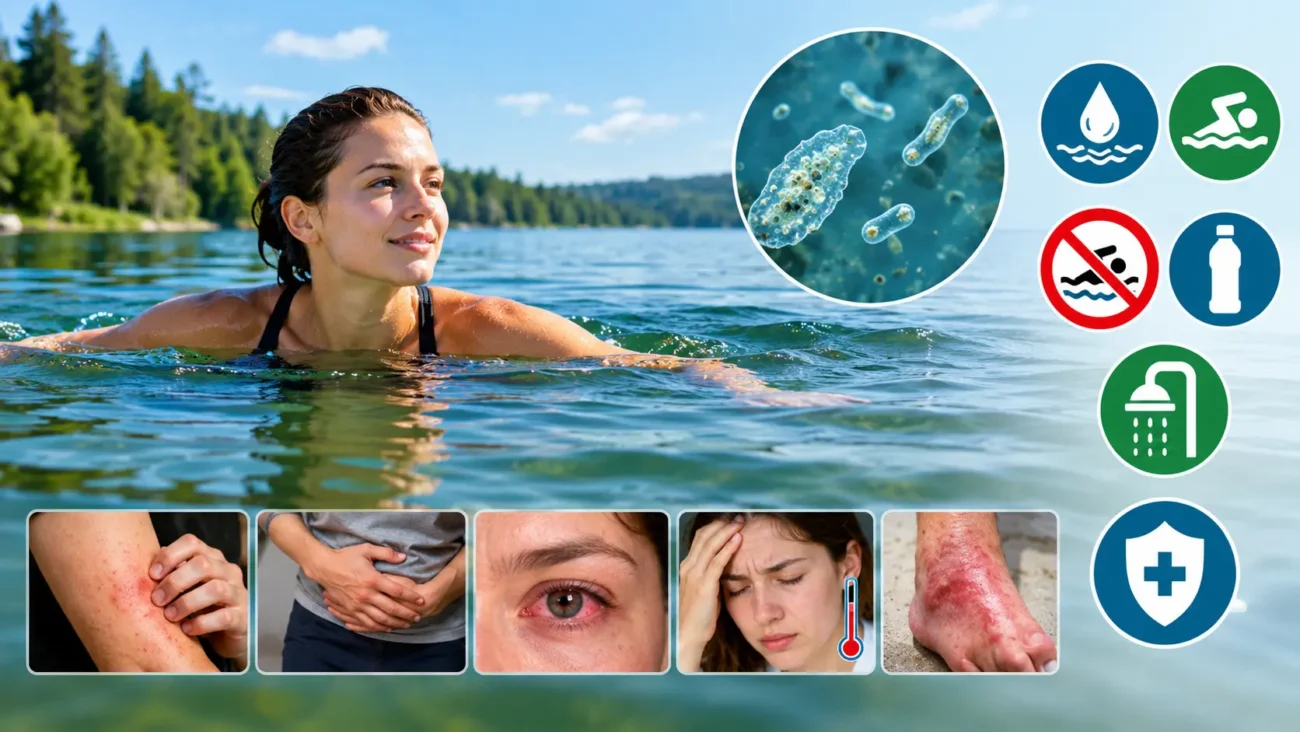
| Quick Answer Freshwater infections are extremely rare, but you can lower your risk further by keeping water out of your nose. Use a nose clip, avoid jumping into warm, shallow, still water, and don’t stir up mud or sediment at the bottom. Watch for headache, fever, or a stiff neck starting days after swimming, and get medical help straight away if these appear. |
Practicing freshwater swimming safety is essential when enjoying lakes, rivers, and ponds during the warm summer months. While swimming in natural water bodies is a great way to cool off, understanding the basic safety precautions and potential risks helps keep you and your family protected.
Splashing about in a lake or river on a hot day is one of life’s simplest joys. It’s also, for almost everyone, completely safe. But you may have seen a news story about a rare and serious brain infection linked to warm freshwater, and wondered whether you should still let your kids jump off that dock this summer. Here’s the honest, straightforward answer: the risk is tiny, but knowing the facts means you can enjoy the water with confidence instead of worry.
What Is This Rare Infection, Exactly?
The infection, which has caused the scare, is known as primary amebic meningoencephalitis (PAM). The pathogen that triggers the condition is the Naegleria fowleri – a “brain-eating amoeba” that is frequently found in warm freshwater lakes, ponds, rivers, and hot springs. It feeds on the bacteria present in the sediment and water.
The major point to note is that the disease is not transmitted through ingestion – meaning that simply drinking the contaminated water is not sufficient for infection. Moreover, the infection cannot be passed from one person to another. The only way for the organism to invade the human body is through the nasal passage – the amoeba makes its way to the brain, where it consumes the brain tissue, and causes PAM. It is important to note that the infection is not contracted through the oral cavity, skin, or the ears.
How Rare Is It, Really?
This is where the statistics come into play, as headlines can exaggerate information beyond its reality. The CDC has reported 180 cases of PAM nationwide from 1937 to 2025, meaning that only a handful of cases occur on average each year throughout the country. When compared to the number of individuals who participate in water activities in lakes and rivers nationwide during summer, it is evident that the odds are stacked dramatically in favor of the average person.
The infection does appear to have a pattern, following a seasonal trend, occurring more frequently in the warmer months of the year in states such as Texas and Florida. It predominantly affects males of that age group, being particularly prevalent in the months of July and August, when the temperature of the water is at its warmest. Sadly, the infection has a near 100% mortality rate once symptoms present, which is why the focus should be on prevention rather than treatment.
Symptoms to Watch For
Symptoms of PAM usually start around five days after exposure, though they can appear anywhere from one to twelve days later. Early signs are easy to mistake for a regular flu or headache, which is part of what makes this infection so dangerous. Keep an eye out for:
- A sudden, severe headache
- Fever
- Nausea and vomiting
- A stiff neck
As the infection develops, it can progress quickly to confusion, loss of balance, seizures, and hallucinations. Because it moves so fast, anyone who develops these symptoms after swimming in warm freshwater within the past two weeks should see a doctor immediately and mention the recent swim, even if it seems unlikely to be connected.
Freshwater Swimming Safety: Simple Ways to Protect Yourself and Your Family
The good news is that a few small habits make a real difference. None of these require you to avoid the water altogether — they simply reduce the chance of water forcing its way up your nose.
Keep water out of your nose. This is the single most effective step you can take. A simple nose clip works well, especially for children who love jumping and diving.
Avoid jumping or diving into shallow, warm, still water. Slow-moving ponds and the shallow edges of lakes tend to be warmest, which is exactly where the amoeba is most likely to be active.
Keep your head above water in hot springs or warm, undisturbed lakes, particularly during the hottest months of summer.
Don’t stir up the sediment. The amoeba lives in mud and silt at the bottom of lakes and ponds, so try to avoid digging around or kicking up the bottom while wading.
Choose well-maintained, chlorinated pools when possible. Naegleria fowleri does not survive in properly treated and chlorinated water, so a well-run public pool carries essentially no risk.
Be extra cautious during heatwaves. The CDC notes that prolonged hot weather raises water temperature and lowers water levels, creating more favourable conditions for the amoeba to thrive.
Is It Ever Found in Tap Water?
In very rare instances, yes. The CDC has investigated a few cases that are associated with tap water, but in each case the infection was obtained by nasal rinsing or irrigation with unboiled tap water, not by swimming. If you are using a neti pot or doing a sinus rinse, the recommendation is to use distilled or sterile water, or water that has been boiled and then cooled, not tap water.
The Bottom Line
Freshwater swimming is one of the safest and most enjoyable summer activities there is, and this infection is rare even during the warmest times of the year. A nose clip, some caution when diving into warm shallow water, and an awareness of the tell-tale early symptoms are all that stand between you and this particular threat. Don’t let a threat so rare ruin your summer fun by taking a few sensible precautions.
Frequently Asked Questions
Can you get infected from swallowing lake water?
No. Swallowing contaminated water does not cause this infection. It only happens when water is forced up the nose and reaches the brain.
Is the infection contagious between people?
No, it cannot spread from person to person. Every case comes from direct exposure to contaminated water.
Does chlorine kill the amoeba?
Yes. Naegleria fowleri does not survive in properly maintained and adequately chlorinated swimming pools.
What time of year is the risk highest?
Risk is highest during July, August, and September, when freshwater temperatures are at their warmest.
Should I stop my children swimming in lakes?
Not necessarily. The infection is extremely rare. Using a nose clip and avoiding jumping into warm, shallow, still water are simple, practical precautions rather than reasons to avoid swimming altogether.



What Is Fibermaxxing? Benefits, Foods & Health Facts
