
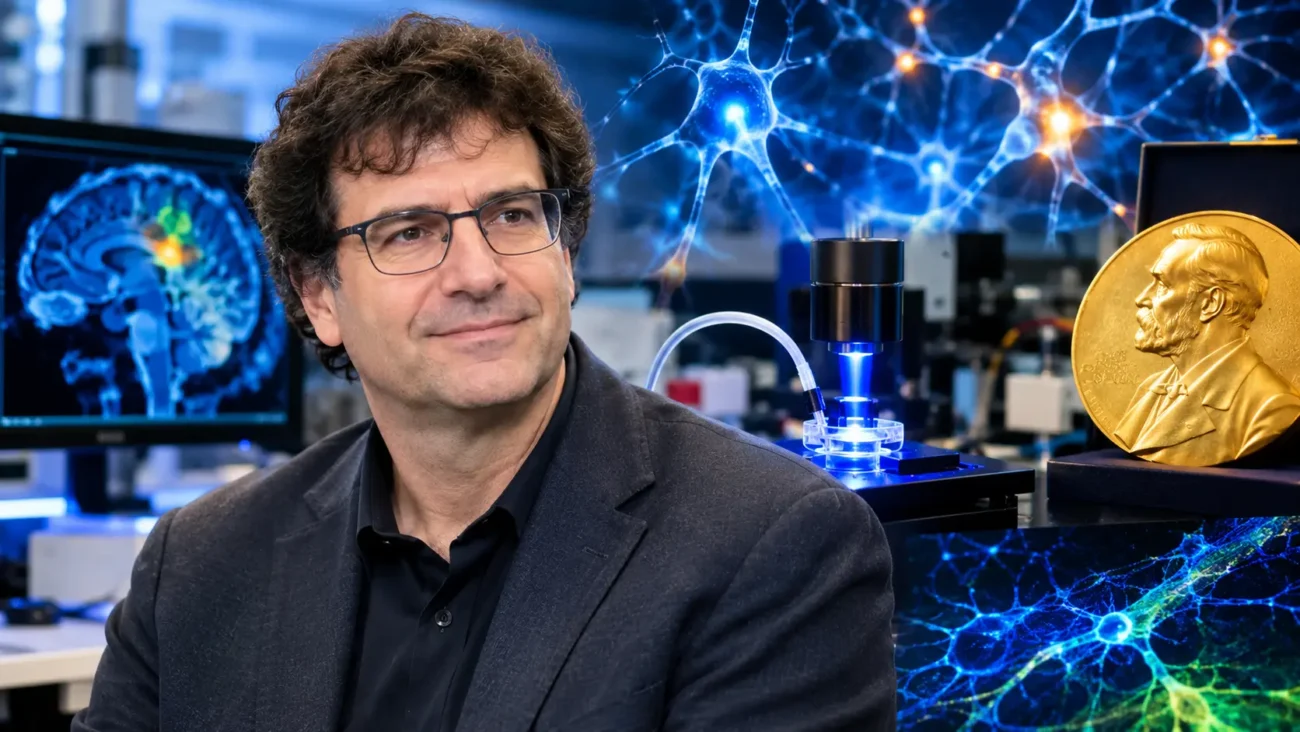
| Quick Answer Karl Deisseroth is an American scientist and psychiatrist at Stanford University. On 5 October 2026, he won the Nobel Prize in Physiology or Medicine for inventing optogenetics, a tool that uses light to control brain cells. He shares the prize with Peter Hegemann and Georg Nagel. |
Who Is Karl Deisseroth?
Karl Deisseroth is a double personality. First, during daytime, he treats the patients who have different psychological diseases, such as depression. During the whole evening, he continues to perform his work in the Stanford University in California, where he got engaged into complex researches that relate to the function of the human brain.
The main invention of Karl Deisseroth is referred to as optogenetics, which allows the scientists to control the activity of specific neurons by implementing a special flash of lights. Considering the level of development of modern medicine, such a fascinating tool has received worldwide acclaim, and in October 2026, Karl Deisseroth was awarded with the Nobel Prize in Physics for his contribution to the field of neurology.
Early Life and Education
Karl Deisseroth was born on 18 November 1971 in Boston, Massachusetts. He was always drawn to the brain, even before he had any formal science training.
- Studied biochemical sciences at Harvard University for his first degree
- Earned a PhD in Neuroscience from Stanford University in 1998
- Completed his MD (medical degree) at Stanford in 2000
- Finished his psychiatry residency at Stanford in 2004
That mix of medicine and lab science is rare. It’s also exactly why his work has had such a big real-world impact — he understands both the biology and the patients living with brain disorders.
Karl Deisseroth’s Career at Stanford
Deisseroth opened his own lab at Stanford in 2004, the same year he finished training. Today he holds the title of D.H. Chen Professor of Bioengineering and of Psychiatry and Behavioural Sciences, and he has been an investigator with the Howard Hughes Medical Institute (HHMI) since 2014.
He still practises psychiatry, too. He treats patients with treatment-resistant depression, autism spectrum conditions, and other complex cases, using a mix of medication and brain stimulation techniques. Few Nobel laureates split their week between a lab bench and a patient’s bedside quite like he does.
What Is Optogenetics? (Explained Simply)
Here’s an easy version. Years ago, two other scientists, Peter Hegemann and Georg Nagel, found a peculiar protein in some algae that grows in ponds. This protein opens the channel on the cell membrane of algae when exposed to light and causes the passage of charged particles.
Deisseroth asked himself a bold and simple question if the same principle could be applied to the brain. He managed to insert this gene into brain cells and was the first one to be able to turn specific brain cells on and off with a flash of light and observe the changes.
Nowadays, many research teams around the world are using optogenetic ways to study depression, anxiety, addictions, and Parkinson’s disease and have even managed to reverse the effects of Parkinson’s in mice, which means that a cure for humans is now possible.
Karl Deisseroth Nobel Prize 2026: What Happened
On 5 October 2026, the Nobel Committee in Stockholm announced that Karl Deisseroth, Peter Hegemann, and Georg Nagel would share the Nobel Prize in Physiology or Medicine “for their discoveries concerning light-gated ion channels and optogenetics.”
The call came in the small hours of the morning. Deisseroth later told the press that he had just fallen asleep when the phone rang. His first reaction was surprise, he said. “I was quite surprised,” he said, according to his own words. His family celebrated with him at home the next day, and when asked how he planned to mark the moment they asked, he made a very scientific comment; that he would get back to work.
Stanford University called him a defining figure in modern neuroscience, and his colleagues praised him for freely sharing his tools and training with scientists all over the world rather than keeping them private.
Other Major Awards and Achievements
The Nobel Prize is the latest entry on an already long list. Some of his other honours include:
- Breakthrough Prize in Life Sciences (2015)
- Albany Medical Center Prize (2015)
- Lasker Basic Medical Research Award (2021)
- Louisa Gross Horwitz Prize, Columbia University (2022)
- Japan Prize in Life Sciences (2023)
- Kyoto Prize for causal systems neuroscience (2018)
Alongside optogenetics, Deisseroth also helped invent CLARITY, a method that makes brain tissue see-through so scientists can study its structure in incredible detail without slicing it apart.
Why Karl Deisseroth’s Work Matters to You
You might be thinking, this is interesting, but how does it affect me? Here’s the honest answer: optogenetics is a research tool, not a treatment you’d get at a clinic today. But the understanding it has unlocked is already shaping new approaches to depression, Parkinson’s disease, and epilepsy, including better-targeted brain stimulation therapies. Basic science like this quietly lays the groundwork for the treatments of tomorrow.
Quick Answers
Who is Karl Deisseroth in simple words?
He’s an American doctor and scientist at Stanford University. He treats patients as a psychiatrist, and he also runs a lab that studies the brain.
What did Karl Deisseroth win the Nobel Prize for?
He won the 2026 Nobel Prize in Physiology or Medicine for optogenetics, a method that uses light to switch brain cells on and off.
Does Karl Deisseroth still see patients?
Yes. He is a practising psychiatrist at Stanford, caring for people with depression, OCD, and autism spectrum conditions, alongside his research work.
How old is Karl Deisseroth?
He was born on 18 November 1971 in Boston, making him 54 years old at the time of his Nobel win.
Who did Karl Deisseroth share the Nobel Prize with?
He shared it with Peter Hegemann of Humboldt University of Berlin and Georg Nagel of the University of Würzburg.
What is optogenetics used for today?
Scientists use it to study depression, anxiety, addiction, and Parkinson’s disease, and it is helping researchers design better brain treatments.
Further Reading and Resources
- Official Nobel Prize press release — https://www.nobelprize.org/prizes/medicine/2026/press-release/
- Stanford Medicine news report — https://med.stanford.edu/news/all-news/2026/10/deisseroth-nobel-prize.html
- Howard Hughes Medical Institute announcement — https://www.hhmi.org/news/karl-deisseroth-2026-nobel-prize-physiology-medicine
- Scientific American coverage — https://www.scientificamerican.com/article/2026-nobel-prize-in-physiology-or-medicine-awarded-to-karl-deisseroth-george-nagel-and-peter-hegemann-for-work-on-optogenetics/